Metatron Intelligence

Metatron Standard · Version 1.0 · 20.11.2026

Jede Handlung sagt vorher, was sie bringen soll.

Sie wissen nicht, welcher Kanal, welches Werkzeug oder welches KI-Modell wirklich liefert? Mit dieser Methode schreibt jede Handlung vorher ihre Erwartung auf und wird am Prüftag gemessen. Die Abweichung zeigt, was als Nächstes zuerst kommt.

Ihr nächster Schritt: Lektion 1 zeigt Schritt 1 in fünf Minuten. Lieber bauen lassen? Der Qube ist Ihr Arbeitsraum für KI-Agenten: Wir studieren Ihre Firma, bauen diese Messung ein, und Sie geben jeden Schritt frei. Einmal 10.000 EUR Festpreis. Zum Qube

154 Muster mit Erwartung und Messung

Stand 20.11.2026: Jedes der 154 Muster in unserem Weltmodell trägt eine Erwartung und eine Messung, von Vertriebswegen bis zu Arbeitsschritten. Allein für die 11 eingesetzten KI-Modelle stehen 26.809 gemessene Anläufe darin.
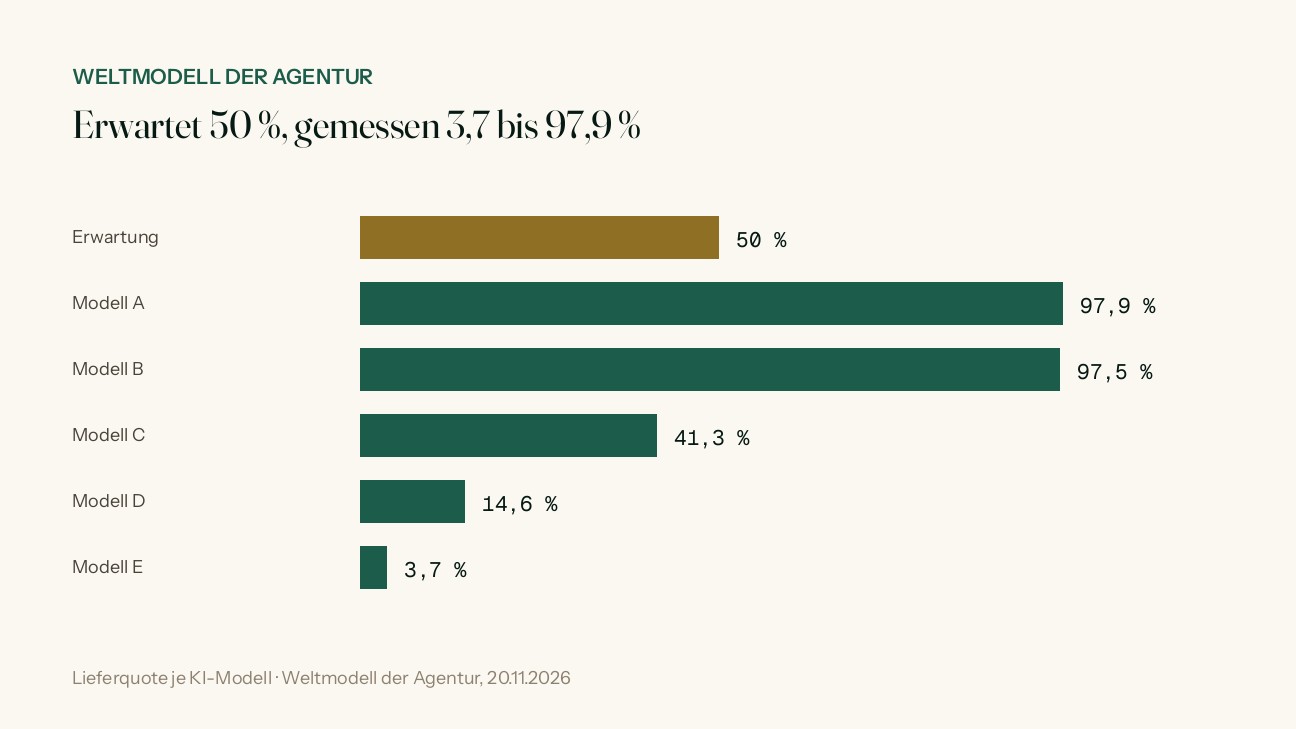
Balkengrafik: einheitliche Erwartung von 50 Prozent gegen die gemessene Lieferquote von fünf KI-Modellen zwischen 3,7 und 97,9 Prozent

Warum es so gemacht wird

Ein Weltmodell ist eine Liste, in der jede Handlung vorher ihre Erwartung und danach ihr Ergebnis trägt. Ein Plan nennt Ziele; das Weltmodell prüft jede Handlung an einem festen Tag. So lernt die Agentur aus jeder Handlung, nicht nur aus Kampagnen.

Die Grafik zeigt, warum die Messung zählt. Lieferquote heißt: Anteil der Aufträge, in denen ein KI-Modell ein verwertbares Ergebnis lieferte. Erwartet waren für jedes Modell 50 Prozent. Gemessen lagen die fünf gezeigten von 11 Modellen zwischen 3,7 und 97,9 Prozent. Seitdem bestimmt die gemessene Quote, welches Modell zuerst arbeitet.

Verwandte Forschung: Die Arbeit arXiv 2601.13247 nutzt Vorhersagefehler, damit Agenten ihr Bild der Welt an Erfahrung anpassen.

Die Methode in fünf Schritten

  1. Erwartung ansagen. Vor jeder Handlung stehen eine Zahl und ein Prüftag: was sie bringen soll und wann gemessen wird. Lektion 1
  2. Ergebnis schreiben. Jede Handlung schreibt beim Abschluss ihr Ergebnis in dasselbe Register wie die Erwartung.
  3. Fehler rechnen. Am Prüftag gilt: gemessen minus erwartet. Das ist der Vorhersagefehler. Lektion 2
  4. Lektion weitergeben. Wer als Nächster im selben Bereich handelt, liest den Fehler, bevor er beginnt.
  5. Reihenfolge nach Messung. Wege, Werkzeuge und Modelle werden nach der gemessenen Quote geordnet, nicht nach Vorgabe.

Ihr nächster Schritt

Lernen Sie den ersten Schritt in Lektion 1: Erwartung vor dem Handeln. Der Qube ist unser Angebot: Wir studieren Ihre Firma und bauen das Fundament, auf dem KI-Agenten für Sie arbeiten. Zu Ihrem Qube
Fachquelle und Lektionen

Metatron Standard · Version 1.0 · 20 Nov 2026

Every action states first what it should deliver.

You don't know which channel, tool or AI model really delivers? With this method, every action writes down its expectation first and is measured on the review date. The gap shows what comes first next.

Your next step: Lesson 1 teaches step 1 in five minutes. Rather have it built? The Qube is your workspace for AI agents: we study your company, build this measurement in, and you approve every step. One-off 10,000 EUR fixed price. To the Qube

154 patterns with expectation and measurement

As of 20 Nov 2026, each of the 154 patterns in our world model carries an expectation and a measurement, from sales channels to work steps. For the 11 AI models we use alone, it holds 26,809 measured attempts.

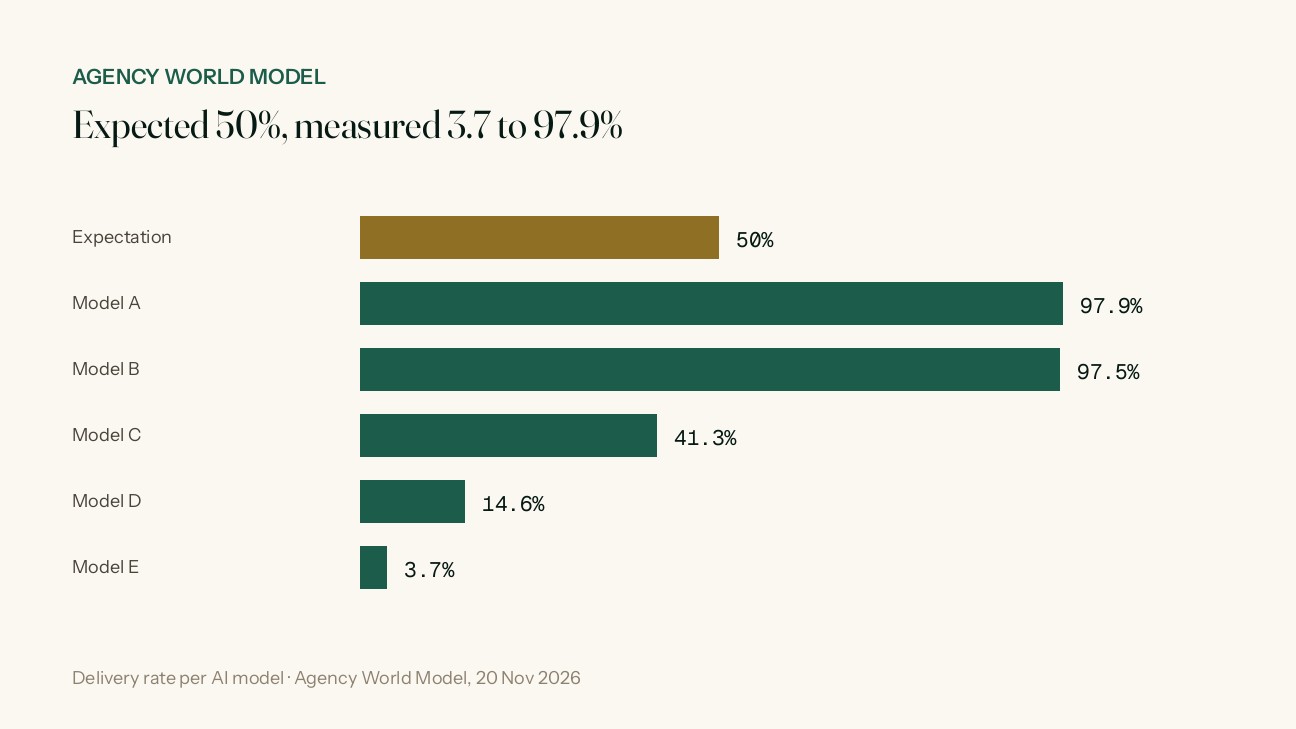
Bar chart: a uniform expectation of 50 percent against the measured delivery rate of five AI models between 3.7 and 97.9 percent

Why it is done this way

A world model is a list in which every action carries its expectation before and its result after. A plan names goals; the world model checks every action on a fixed date. So the agency learns from every action, not just from campaigns.

The chart shows why measurement matters. Delivery rate means: share of jobs in which an AI model delivered a usable result. The expectation for every model was 50 percent. Measured, the five shown of 11 models ranged from 3.7 to 97.9 percent. Since then, the measured rate decides which model works first.

Related research: arXiv 2601.13247 uses prediction errors so agents adjust their picture of the world to experience.

The method in five steps

  1. State the expectation. Before every action there is a number and a review date: what it should deliver and when it is measured. Lesson 1
  2. Write the result. Every action writes its result into the same register as its expectation when it finishes.
  3. Calculate the error. On the review date: measured minus expected. That is the prediction error. Lesson 2
  4. Pass the lesson on. Whoever acts next in the same area reads the error before they start.
  5. Order by measurement. Channels, tools and models are ranked by the measured rate, not by default.

Your next step

Learn the first step in Lesson 1: Expectation before action. The Qube is our offer: we study your company and build the foundation your AI agents work on. Go to your Qube

Reference and lessons