Reader's guide r0056
Start here.
This publication asks you to check it rather than believe it. That only works if you know how a record is built — which takes about ten minutes.
Below: the four parts of every record, the order to read the site in, what each of the eight desks is for, the coverage of the source layer and what it deliberately does not cover, and a plain definition of every term this publication uses. Nothing here assumes prior knowledge of the subject.
- Reading time
- about 10 minutes
- Applies to revision
- r0056
- Reviewed
- Loading
- Reading the current evidence layer…
Step one · the anatomy of a record
One record,
taken apart.
The record on the left is live: one of the 42 signposts in the current layer, pulled at page load. The markers on it match the numbered explanation beside it.
- Loading
- Reading the current evidence layer…
- 01
The observation is the claim
One statement, bounded, with the date on which it was recorded. It says what was seen — not what it means for you, and not what happens next.
- 02
The threshold was fixed first
Before the observation existed, someone wrote down what would have to happen for this scenario to count as observed. You can check the claim against that line instead of against a mood.
- 03
The counter-evidence is printed, not buried
The record carries what the evidence does not establish, in the same type size as the finding. If this section is empty, the record is not finished.
- 04
The update condition keeps it alive
It names the observation that would move the state. That is what makes this a live reading rather than a dated opinion.
- 05
The source is a route you can walk
Publisher, date, language and canonical URL. Follow it. If it no longer resolves, that is recorded too, and the claim weakens accordingly.
Step two · the order to read in
Four steps,
in this order.
Read them out of order and you will meet a claim before you can judge it. Each step names what it costs you in time, so you can stop at any point and still have gained something whole.
Learn how a record is built
Four parts: the claim, the source, the non-claim, the update condition. Ten minutes here makes every other page on this site readable.
10 minutes · start hereSee what changed the reading
Timestamped observations against thresholds fixed in advance. This is the shortest route to what is actually new.
5 minutes · current stateFollow one question into the evidence
Twenty-four connected domains, exact sources, visible uncertainty. Pick a claim and walk it down to the document it rests on.
20 minutes · deepCheck the work against its own rules
The evidence-quality ledger, the correction record and the editorial compact. Read it before you trust anything above.
10 minutes · auditStep three · which desk answers which question
Pick by the question,
not the subject word.
Eight desks, each with a job. The description under each one says when to open it — the situation you are in, not the topic it covers.
Models & Capabilities
Read this desk when you need to know what a system can actually do, as opposed to what its launch material says it does.
Open desk →AI-AGTAgents & Automation
Read this desk when the question is whether a system can be trusted to run unattended over hours, not whether it answers well once.
Open desk →AI-INFCompute, Chips & Cloud
Read this desk when the constraint is physical: silicon, power, cooling, capacity that has to be built before it can be sold.
Open desk →AI-DATData & Research
Read this desk when a number is doing persuasive work and you need to know how it was produced before you repeat it.
Open desk →AI-SGRSafety, Governance & Regulation
Read this desk when an obligation is about to become a product decision, a deadline or a liability.
Open desk →AI-ECWMarkets, Capital & Work
Read this desk when the money and the labour question matter more than the capability question.
Open desk →AI-SECSectors & Applications
Read this desk when you want the evidence from one industry rather than a general statement about all of them.
Open desk →AI-GEOGeopolitics & Society
Read this desk when the decisive actor is a state, a bloc or a public, not a company.
Open desk →Step four · the Global AI Source Observatory
Where the evidence
comes from.
Coverage is not completeness. The map is drawn from 23 reviewed official discovery routes, and it is shaded for visible missingness: the jurisdictions nobody has reviewed stay on the map instead of disappearing into an average.
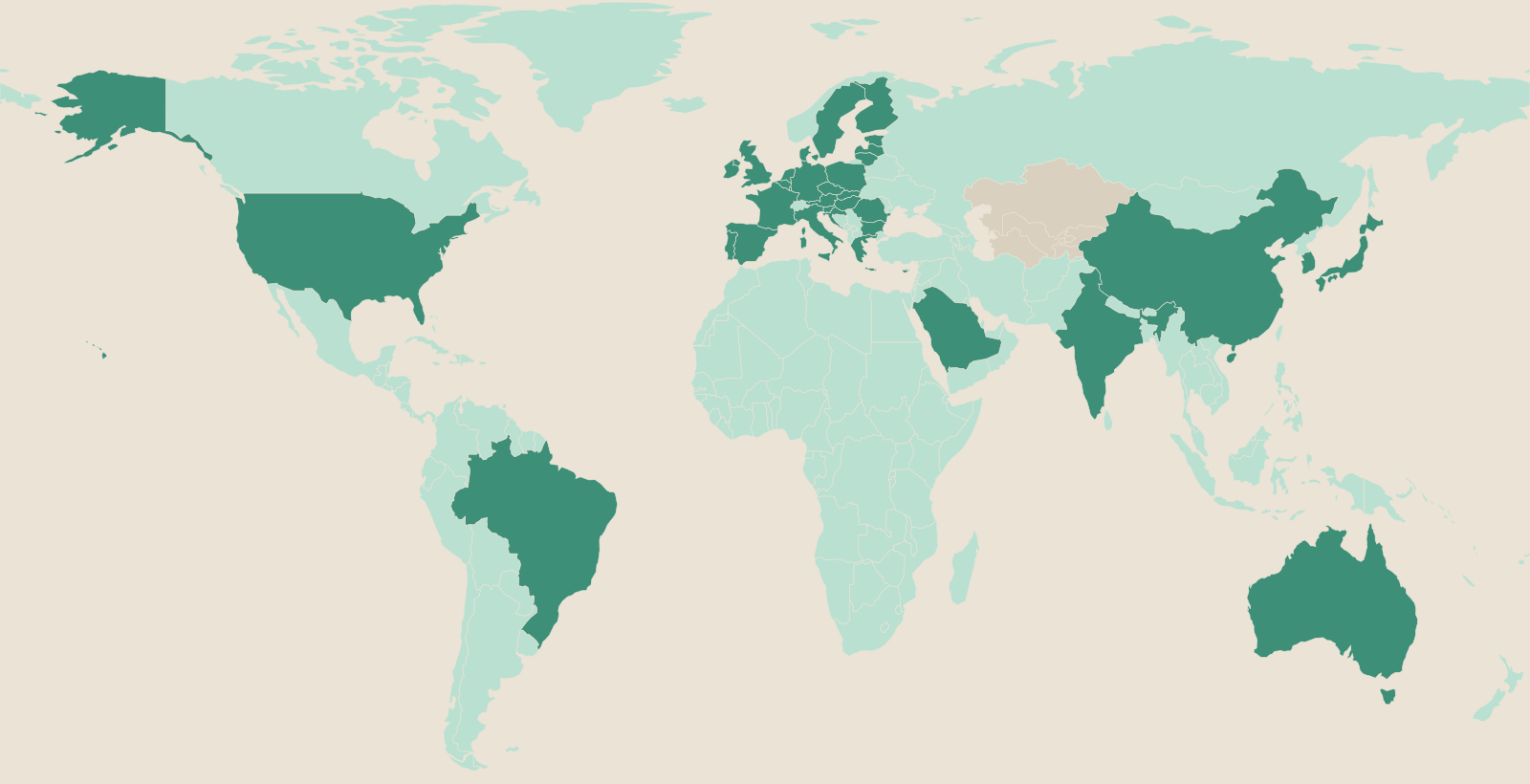
- Reviewed route
- Region covered, jurisdiction not
- No reviewed route
- East Asia 3/6 countries7 routes30%
- Global / multilateral no territory4 routes17%
- Europe 27/44 countries2 routes9%
- Latin America & Caribbean 1/29 countries2 routes9%
- South Asia 1/7 countries2 routes9%
- Southeast Asia 1/11 countries2 routes9%
- Africa 0/44 countries1 route4%
- Middle East & North Africa 1/21 countries1 route4%
- North America 1/4 countries1 route4%
- Oceania 1/7 countries1 route4%
What this map is not
- Regional representation is not country completeness; many jurisdictions have no reviewed local primary route.
- Most official sources publish intent and institutions more readily than execution, budget outturn, enforcement or measured effects.
- Subnational rules, courts, procurement, defense uses and non-public deployments remain materially underrepresented.
- Machine-readable APIs, versioned exports and correction feeds are rare or were not verified for most routes.
- Local-language access is uneven, and translated editions may lag or differ from authoritative originals.
This registry records reviewed discovery routes and explicit gaps. Every factual claim still requires a separate source capture, locator, rights check and editorial admission receipt.
Step five · every term, once
The words this
publication uses.
Each of these has a narrow meaning here. Where the general usage is looser, the narrow one wins — that is what makes the records comparable to each other.
- Claim
- One bounded statement that a named source supports. It is written narrowly on purpose: attention, adoption, revenue and welfare are never silently collapsed into one word such as “growth”.
- Source
- The canonical route to the document behind a claim, with publisher, date, language and transport state. If the route stops resolving, the record says so rather than quietly keeping the claim.
- Non-claim
- What the cited evidence does not establish, printed next to the finding. This is the part most intelligence products leave out, and it is the part that makes the rest checkable.
- Update condition
- The specific observation that would strengthen, weaken or retire the reading. A record without one is an opinion with a date on it.
- Threshold
- The line that had to be crossed before a scenario counts as observed. It is fixed in advance so that the state cannot be argued into existence afterwards.
- State
- One of observed, emerging, contested or not observed. It is a qualitative reading against a threshold, never a probability, because a probability here would be invented.
- Signpost
- A scenario being watched, with its threshold, its current state and its counter-evidence. Signposts are how a long-running question stays honest between updates.
- Desk
- One of eight stable subject areas. Desks organise discovery; they do not own the evidence. Every consequential route returns to the same Atlas record.
- Entity
- A named organisation, model, chip or programme with statements attached to it, so that the same actor can be followed across desks and domains.
- Domain
- One of 24 connected subject domains inside the Atlas. Domains are how claims relate to each other; desks are how readers find them.
- Reviewed route
- An official discovery route that has been read and recorded — publisher, region, language, access mode, rights boundary. A route is not evidence; it is where evidence can be looked for.
- Correction
- A published change to something already stated. Corrections are counted and kept; a publication that never records one is not more accurate, only less observed.
Step six · what to distrust
Where this
publication is weak.
A guide that only explains the strengths teaches you to be credulous. These are the standing limitations of the current layer, taken from its own published counters.
- 01
Coverage is not completeness
23 reviewed discovery routes across 10 regions is a starting position, not a world census. Whole jurisdictions have no reviewed local route, and the map above shows which.
- 02
Machine-readability is rare
1 of 23 routes are machine-readable, and 0 have had reuse rights formally assessed. Anything built on top of them inherits that fragility.
- 03
Language access is uneven
7 routes are English-only, and translated editions may lag or differ from the authoritative original. A claim resting on a translation is weaker than it looks.
- 04
Nothing here is a forecast
States are qualitative readings against thresholds fixed in advance. Where you want a probability, this publication will decline to invent one, and that will occasionally be inconvenient.
You are ready
Now open a record
and try to break it.
The Atlas is the canonical layer: 3,258 claims, 2,484 sources, 24 connected domains. If a record does not survive your check, the correction record is public and the route to it is on every page.
Open the World Innovation & Trend Atlas →